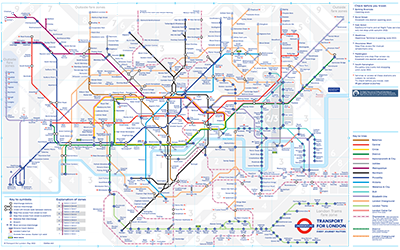
The London Underground, affectionately known as the Tube, is a deep and fascinating aspect of London’s rich history and culture. With its intricate network of lines and stations, it serves as both a vital transport system and an iconic symbol of the city’s heritage.
1.The Tube Map11198 votes
The iconic map of the London Underground was designed by Harry Beck in 1931. His innovative design, utilizing a simplified, color-coded layout, is now a blueprint for metro maps worldwide.
💡 Beck's design was originally criticized but has since become famous and influential.
2.Number of Stations9453 votes
The London Underground consists of 272 stations, making it one of the largest metro systems in the world. Each station has its own unique architecture and history that reflects the diverse culture of London.
💡 The stations serve over 5 million passengers daily.
3.Annual Passengers9259 votes
In a typical year, the London Underground carries around 1.3 billion passengers. This high volume of ridership makes it one of the busiest metro systems globally.
💡 The ridership can significantly fluctuate due to events like the COVID-19 pandemic.
4.Oldest Underground Line9104 votes
The Metropolitan Line is the oldest line of the London Underground, having opened in 1863. It was initially created to reduce congestion on the streets of London and now spans 65 miles.
💡 The line was initially powered by steam locomotives.
5.First Line Opened8649 votes
The first section of the London Underground opened in 1863, running between Paddington and Farringdon. This pioneering development not only transformed urban transport but also laid the groundwork for extensive network expansions in subsequent decades.
💡 The Metropolitan Line was the world’s first underground railway.
6.Deepest Tube Station8326 votes
The deepest station on the London Underground is Hampstead, located 58.5 meters (192 feet) below ground level. This unique depth adds to the station's charm and challenges for the construction and operations.
💡 Hampstead was opened in 1907 and is part of the Northern line.
7.Total Length8145 votes
The London Underground has a total length of approximately 402 kilometers (249 miles) of track. This makes it one of the longest underground rail networks in the world.
💡 The length includes both the deep-level and surface sections of the network.
8.Safety Innovations7252 votes
The London Underground was one of the first transport systems to introduce safety innovations such as emergency alarms and CCTV. These systems are continuously upgraded to ensure passenger safety.
💡 The focus on safety has led to a reduction in accidents and improved emergency response times.
9.Overground Connection5866 votes
In 2007, the London Overground was established as a separate network that connects with the Underground. This expansion greatly improved transport links in and around London.
💡 The Overground connections enhance the overall efficiency of London's public transport system.
10.The Tube’s Nickname5404 votes
The London Underground is lovingly referred to as 'The Tube' due to the circular shape of its deep-level tunnels. This term has become synonymous with London's public transport system.
💡 The nickname 'The Tube' was popularized in the 1900s.
11.Busiest Station5303 votes
Waterloo Station is recognized as one of the busiest stations in the London Underground network, serving millions of passengers each year. Its strategic location and high traffic highlight the critical role of the Tube in London’s daily commuting.
💡 Waterloo is also a major railway station, connecting to multiple services across the UK.

12.Art on the Underground4718 votes
Art on the Underground is an initiative that enhances the Tube experience with temporary art installations across stations. This program showcases works from local, national, and international artists.
💡 The program has featured pieces from renowned artists, adding cultural value to the commuting experience.
13.First Electric Tube4517 votes
The first electric underground railway in the world opened in 1890, connecting Baker Street to Paddington. This marked the beginning of the transition from steam-powered to electric trains in the Underground.
💡 The line was known as the City and South London Railway.
14.Iconic Roundel3606 votes
The London Underground's roundel logo is a classic symbol recognized not just in London but around the world. This design is not merely iconic but represents the Tube's enduring presence in the city's transportation culture.
💡 The roundel was designed in 1908 and has become synonymous with the London Underground.
15.Behind the Scenes Tours2920 votes
There are special behind-the-scenes tours available for those interested in the workings of the Underground. These tours provide insights into the operation, history, and maintenance of the system.
💡 Tours can include visits to control rooms and depots that are not usually accessible to the public.