This list highlights fundamental music theory concepts essential for understanding and creating music. These concepts serve as the building blocks for musicians and composers, enabling a deeper appreciation and effective communication of musical ideas.

1.Harmony15237 votes
Harmony refers to the combination of simultaneously sounded musical notes to produce chords and chord progressions that underpin a piece of music. It enriches melodies and adds emotional depth, shaping the overall sound and mood.
💡 Harmony has evolved significantly from simple intervals to complex chord structures across different musical eras.

2.Scales14058 votes
Scales constitute a series of notes arranged in ascending or descending order, forming the basis for melody and improvisation. They establish tonal centers and affect the mood and character of music.
💡 Major and minor scales are among the most common, but there are many other types such as pentatonic, chromatic, and modal scales.
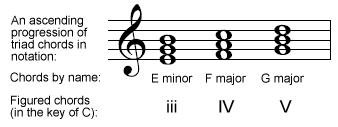
3.Chord Progressions13138 votes
Chord progressions are sequences of chords that form the harmonic foundation of a piece of music. They guide emotional flow and structural coherence, often defining the style and genre.
💡 Popular progressions include I–IV–V–I in Western music, often associated with all kinds of musical styles.

4.Key Signature2894 votes
A key signature indicates the sharps or flats at the beginning of a piece, defining the key it is written in. It simplifies notation by avoiding repeated accidentals throughout the piece.
💡 Key signatures are based on the circle of fifths and help musicians quickly identify tonal centers and related scales.

5.Interval2850 votes
An interval is the distance between two pitches, measured in steps or semitones. Understanding intervals is fundamental for building melodies, harmonies, and chord structures.
💡 Intervals are classified into perfect, major, minor, augmented, and diminished categories, forming the building blocks of music.

6.Cadence2841 votes
A cadence is a melodic or harmonic configuration that creates a sense of resolution at the end of a phrase. It is fundamental in establishing the musical punctuation and phrase structure.
💡 Perfect cadences are often used to conclude sections, giving a strong sense of finality, whereas imperfect cadences tend to be more open-ended.

7.Timbre2793 votes
Timbre, also known as tone color, describes the unique quality or color of a musical sound that distinguishes different instruments or voices. It gives music its expressive character.
💡 Timbre is influenced by aspects such as harmonics, attack, and decay, and is crucial for identifying and differentiating sounds in music.
8.Triad2773 votes
A triad is a three-note chord made up of a root, third, and fifth, forming the basic building block of Western harmony. They are essential in constructing harmonies and melodies.
💡 Triads can be major, minor, diminished, or augmented, each producing unique harmonic qualities.

9.Voice Leading2545 votes
Voice leading is the smooth movement of each individual melodic line within a musical composition. It governs how individual voices or parts move from one chord to another, ensuring harmonic and melodic coherence.
💡 Efficient voice leading minimizes awkward leaps and awkward intervals, contributing to fluid and pleasing harmonic progressions.

10.Modes2401 votes
Modes are scales derived from the traditional major scale but start from different notes, producing unique tonal characteristics. They were widely used in Medieval and Renaissance music and influenced modern modal jazz.
💡 The seven modes include Dorian, Phrygian, Lydian, Mixolydian, Aeolian, and Ionian, each with distinct interval patterns.
11.Tonic2397 votes
The tonic is the first and main pitch of a scale and serves as the tonal center of a piece. It provides a sense of stability and resolution in Western music.
💡 The tonic chord is often the point of return or resolution, and much of Western harmony revolves around it.

12.Polyphony2245 votes
Polyphony is a musical texture involving two or more independent melodic lines occurring simultaneously. It was predominant in Renaissance and Baroque music and continues to be fundamental in complex compositions.
💡 Polyphony allows for rich, intertwining melodies and was a key feature in the development of European sacred and secular music.

13.Dissonance1897 votes
Dissonance refers to a combination of tones that sound unstable or tense, creating a need for resolution. It is essential for adding emotional tension and interest to music.
💡 Over time, the perception of dissonance has evolved, with some intervals once considered unacceptable now used freely in modern music.

14.Modulation1452 votes
Modulation is the process of changing from one key to another within a piece. It creates variety and maintains interest by shifting tonal centers smoothly or abruptly.
💡 Commonly used in classical and jazz compositions, modulation can signal a new section or emotional change in a piece.
15.Counterpoint1372 votes
Counterpoint is the art of combining multiple independent melodies within a composition. It enhances musical texture and complexity, especially evident in Baroque music like Bach's fugues.
💡 J.S. Bach's mastery of counterpoint was pivotal in shaping Western classical music and is still a core study in music theory education.


